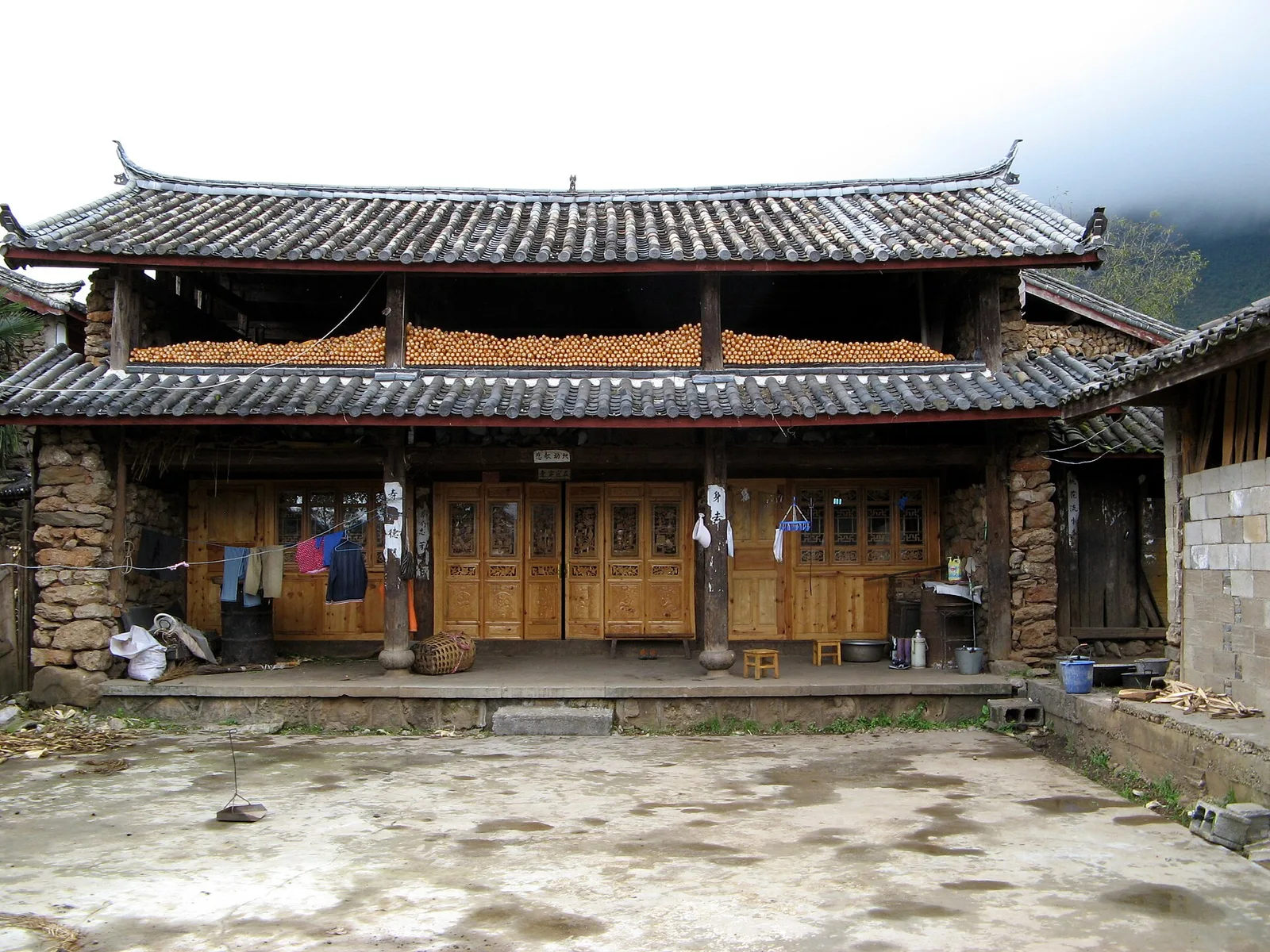
The Naxi house is a courtyard building: wooden frame, mud-brick walls, a stone base, and a gate that faces away from the wind. The details are practical and symbolic at once. Once you can read the basic elements, the old towns and villages become more legible.
In short
Look for the courtyard plan, the carved doors and windows, the mud-brick walls, and the roof pitch. The best examples are in the villages and in restored guesthouses, not on the main shopping streets.
The plan
A traditional Naxi house is organised around a rectangular courtyard, with rooms on three or four sides. The main hall faces the gate, and the gate is often offset to avoid direct sightlines and wind. The courtyard provides light, air, and working space.
The layout is not unique to the Naxi; it belongs to a wider southwest Chinese courtyard tradition. What distinguishes the local version is the proportion, the woodwork, and the way the house sits in the village and the landscape.
Materials and details
The frame is timber, with mud-brick infill and a stone foundation. Roofs are pitched and tiled, with deep eaves that protect the walls from rain. Carved wooden doors, window panels, and brackets carry floral, animal, and geometric motifs.
The carving is where the craft shows. Look at the depth, the repetition, and the condition. Many old houses have been restored with new wood; some have original panels. The Baisha murals show the same visual world in painting.
Orientation matters too. The main hall usually faces south or east for light and warmth, while the gate turns away from the prevailing wind. In a village, the best houses sit slightly above the lane, with steps that keep rainwater out.
Where to see them
The villages around Baisha, Shuhe, and Yuhu have the best concentration of traditional houses. In Dayan, many have been converted, but the structures remain behind the shopfronts. Courtyard guesthouses let you stay inside the form.
Do not enter private courtyards without permission. If a gate is open and someone is working, ask. The Baisha guide and Yuhu guide point to the best streets.
- Look up at the roof pitch and eaves.
- Study the carved door panels.
- Mud brick is a sign of age.
- Ask before entering courtyards.
Verdict
The houses are the old town's best museum; learn the parts and the streets open up.
Next in the manual
04 linksField desk / direct line
Not sure this fits your trip?
Send the dates, the group, and what you are deciding between. The field desk will tell you what to cut and what to keep.
Independent advice. No bookings, no commissions, no visa service.